Learn AI skills for your workplace and business.
Master AI skills to increase your business profitability, workplace productivity, and Stay Ahead – No Coding Required!
Next class starts 3 August 2026


Join 1539+ alumni
Across 6 successful cohorts
Live Cohort Session
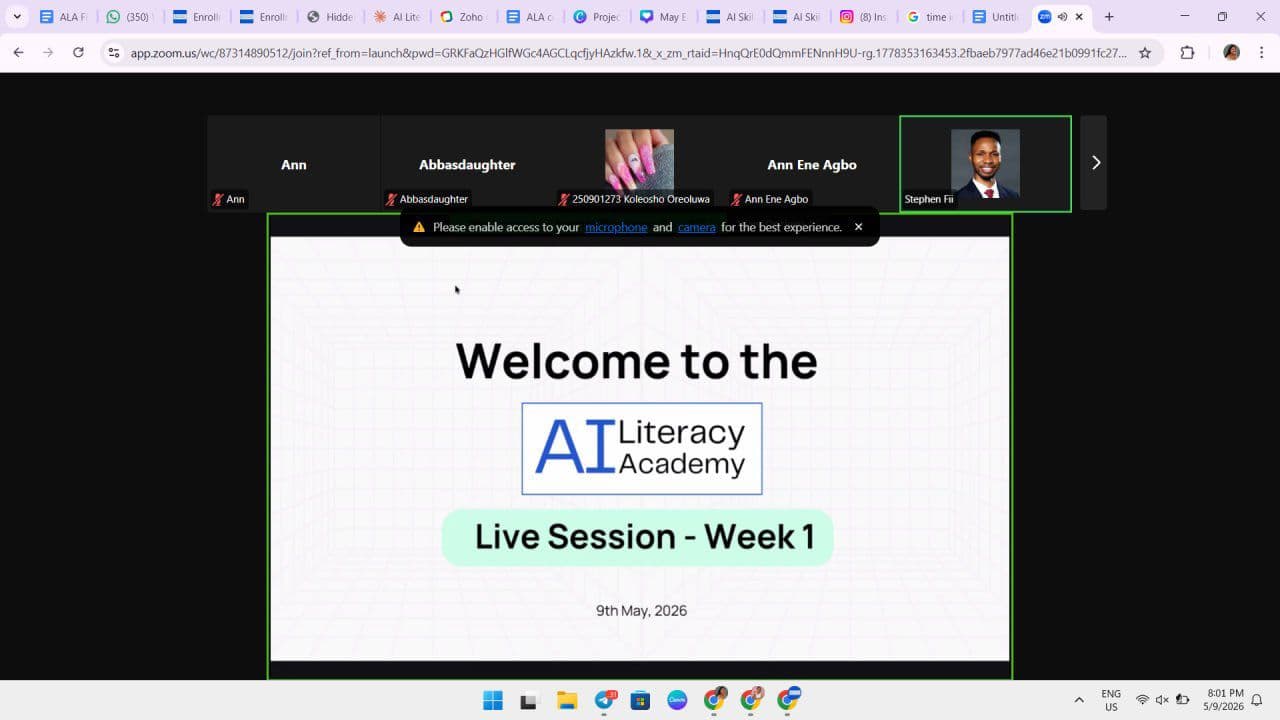
Femi
Can we see the prompt framework again?
1539+
Students Trained
6
Cohorts Done
Supported by

Level up your Career
Gain practical AI skills and certification to stay ahead in your field.
Grow your Business
Discover how to use AI for Marketing, Operations, and strategy.
Freelance your AI Skills
Package your AI expertise into marketable products and services.
AI will not replace humans — but humans with AI will replace humans without AI.
Harvard Business Review
What kind of people join this Academy?
Career Professionals
Future-proof your career, become more efficient at work, and stand out by mastering AI skills employers demand.
Business Owners
Reduce costs, save time, and make more money using AI-powered tools for marketing, sales, and automation.
Freelancers
Explore new income streams by offering AI-driven services or build your personal brand as an AI expert.
AI Beginners
You've heard about AI but don't know where to start. We give you a simple, step-by-step guide to start using AI.
What you'll learn in the Academy
PART 1: Introduction to Generative AI

MODULE 1:
Understanding Generative AI
- 1.What Generative AI is and how it works.
- 2.How to use generative AI in business and the workplace.
- 3.Real world examples of Generative AI in action.
ACTIVITY: Use the ‘AI Workflow Framework’ to identify opportunities for using AI in your work and business.

MODULE 2:
Getting Started with AI Tools
- 4.How to choose the Generative AI tool to use – ChatGPT, Perplexity, Claude, Gemini.
- 5.How to set up an account on Generative AI platforms.
- 6.How to create your first output – Text Generation, Image Creation, Video Creation
ACTIVITY: Create an AI output in text, picture, and video

MODULE 3:
Prompt Engineering
- 7.Introduction to prompt engineering for beginners
- 8.Advanced prompt engineering frameworks to get the best quality of results.
- 9.How to build a Prompt Library for your work or business.
ACTIVITY: Use your ‘prompt stack’ to create high quality AI outputs.

MODULE 4:
Monetizing AI – How to Make Money with Generative AI
- 10.How business owners can make money with Generative AI
- 11.How career professionals and freelancers can make money with Generative AI
- 12.How to create an AI Monetization Roadmap (A step-by-step plan for monetizing AI)
ACTIVITY: Create your ‘AI Monetization Roadmap’ to make money with Generative AI.
PART 2: Generative AI for Business Owners

MODULE 5:
AI for Business Development and Growth
- 13.How to generate and brainstorm business ideas with AI
- 14.How to create a well detailed profitable Business Plan and Business Model Canvas with AI
- 15.How to create a Profitable Business Growth Strategy with AI
- 16.How to create Digital Products with AI (Books, Templates, Guides)
ACTIVITY: Create a Profitable Growth Strategy for your business using Generative AI.

MODULE 6:
AI for Marketing and Branding
- 17.How to create or improve your Branding using AI (Messaging, Tone, Elements)
- 18.How to create Marketing Strategies, target audience research, and funnel building using AI
- 19.How to create a Website landing page using AI
ACTIVITY: Create an entire Marketing Campaign for your product or service using AI

MODULE 7:
AI for Content Creation
- 20.How to create hundreds of human-type text content in minutes and still maintain high quality using AI.
- 21.How to create high quality Picture content using AI
- 22.How to create high quality Video content using AI
ACTIVITY: Create a Brand Picture content for your Business

MODULE 8:
AI for Business Operations and Automation
- 23.How to draft proposals, contracts, and reports with AI.
- 24.How to automate repetitive tasks using AI-enabled tools – Zapier, Make, Zoho Flow.
- 25.How to manage business finance using AI
ACTIVITY: Automate one of your Business operations using AI
PART 3: Generative AI for Career Professionals

MODULE 9:
AI for Workplace Productivity
- 26.How to use AI for Project ideas and Problem-solving
- 27.How to create emails and work responses that are professional and human-like using AI
- 28.How to create or summarize large documents, meetings, and generate professional reports using AI.
- 29.How to use AI for Presentation Slides
- 30.How to use AI tools for task prioritization and productivity tracking
ACTIVITY: Create a Presentation for a Project Idea using AI

MODULE 10:
AI for Career Growth
- 31.How to create a learning roadmap and plan for Career Growth using AI
- 32.How to set up an optimized Linkedin Profile using AI (Summary, Experiences, Education)
- 33.How to create a professional and ATS optimized CV/Resume using AI
- 34.How to create a professional portfolio using AI
- 35.How to apply and get jobs on LinkedIn using AI
ACTIVITY: Create an optimized LinkedIn Profile using AI

MODULE 11:
AI for Personal Branding & Visibility
- 36.How to create a Personal Brand Framework using AI
- 37.How to create brand building posts for LinkedIn and Twitter using AI
- 38.How to create videos for YouTube and Reels using AI
ACTIVITY: Create a Personal Brand Framework for yourself.
PART 4: Generative AI for Freelancers

MODULE 12:
AI for Skill Development
- 39.AI-Powered services you can offer to earn more.
- 40.Showcasing AI-powered work to attract clients.
ACTIVITY: Chose the AI-enabled services you want to offer

MODULE 13:
AI for Client Acquisition (Getting Jobs)
- 41.How to apply and get jobs on Upwork using AI
- 42.Crafting personalized and winning client proposals using AI.
ACTIVITY: Write a compelling pitch or proposal for a real or hypothetical freelance job using AI tools.

MODULE 14:
AI for Service delivery
- 43.Tools and techniques for using AI to improve the quality of deliverables.
- 44.Using AI to streamline workflows, manage multiple clients, and meet deadlines.
ACTIVITY: Complete a small project (e.g., writing, design, or analysis) using AI to streamline processes and document the improvements.

BONUS MODULE:
AI Agents
- 45.What AI agents are and how they help businesses and professionals
- 46.How to build a Productivity Agent with No-Code Tools (Make, Zapier)
- 47.How to create a Chatbot using No-code Tools
ACTIVITY: Create your first AI Agent
It is time to upskill yourself with AI for your career and business.
I want to upskillWhat you will build in 30 days
You won't just watch videos. You will walk away with real, usable assets for your career and business.
Your AI Monetization Roadmap
A step-by-step plan to start earning with AI skills through freelancing or your business.
Your AI Workflow Map
A clear framework showing where AI fits into your daily work and business operations.
Your Business Growth Strategy
An AI-powered business plan with market analysis, marketing strategy, and growth roadmap.
Websites and Web Apps with AI
Build fully functional websites and web applications using AI — no coding experience required.
Videos & content with AI
Create high-converting video and text content using AI to build your brand and audience.
Automations & Digital products with AI
Automate your operations and create digital assets like ebooks and calculators to generate passive income.
This AI Literacy Academy gives you access to:
Video Lessons
Learn at your own pace with engaging, step-by-step video tutorials that break down AI concepts easily.
Templates & Frameworks
Save time with ready-to-use templates and proven frameworks for business and workplace use.
Activities & Portfolio
Practice what you've learned with hands-on exercises and real-world challenges for your portfolio.
No-Code AI Tools
Gain access to user-friendly, no-code AI tools to help you build automations, chatbots, and more.
Community & Support
Join a network of like-minded learners, share ideas, and collaborate to grow your skills and opportunities.
Professional Certification
Earn a certificate of completion that showcases your AI expertise and opens doors to new opportunities.
See All 2026 Cohorts
We run four cohorts every year. Choose the one that works best for your schedule.

FEBRUARY
2026
Enrolment Closed
MAY
2026
Enrolment Closed

NOVEMBER
2026
Coming SoonCan't make August? Join the waitlist for November and we'll notify you when enrolment opens.
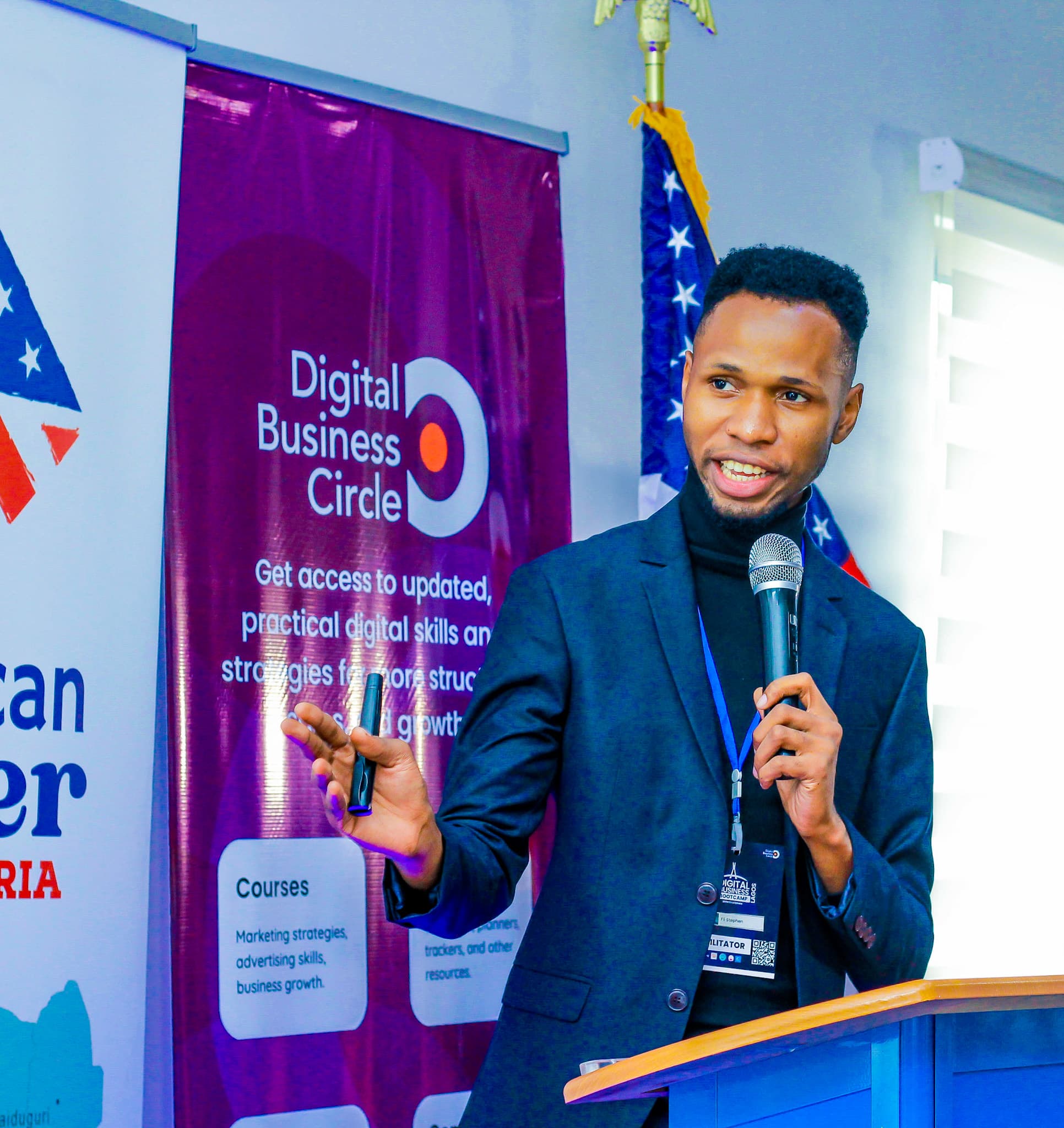
Meet your lead facilitator
Fii Stephen
AI Consultant · 8+ Years Marketing
- Generative AI Certified, IBM
- AI Research Group Member, Centre for AI and Digital Policy, USA
- AI for Marketing Certified, Davidson College, USA
- Oracle Cloud Infrastructure Certified Generative AI Professional
- 8+ years of Marketing Experience
- Managed over $50,000/month ad budget
- LinkedIn Marketing Insider
- Business Development Service Provider, SMEDAN
- EMBA, Quantic School of Business and Technology, Washington DC
- AI Founder Sprint, INSEAD Venture Labs, Fontainebleau, France
How the program is structured
Duration
30 Days (4 Weeks)
Community
Telegram
Live Sessions
Zoom
Schedule
Saturdays 8–9pm WAT
Daily Video Lessons
Pre-recorded practical videos to watch and learn AI skills over 30 days.
Live Sessions
Saturday 8pm–9pm WAT for review, Q&A, and live problem-solving.
Group Mentorship
Group meetings and networking with the Lead Facilitator.
Practical Activities
Assigned tasks to test your AI skills and build your Professional Portfolio.
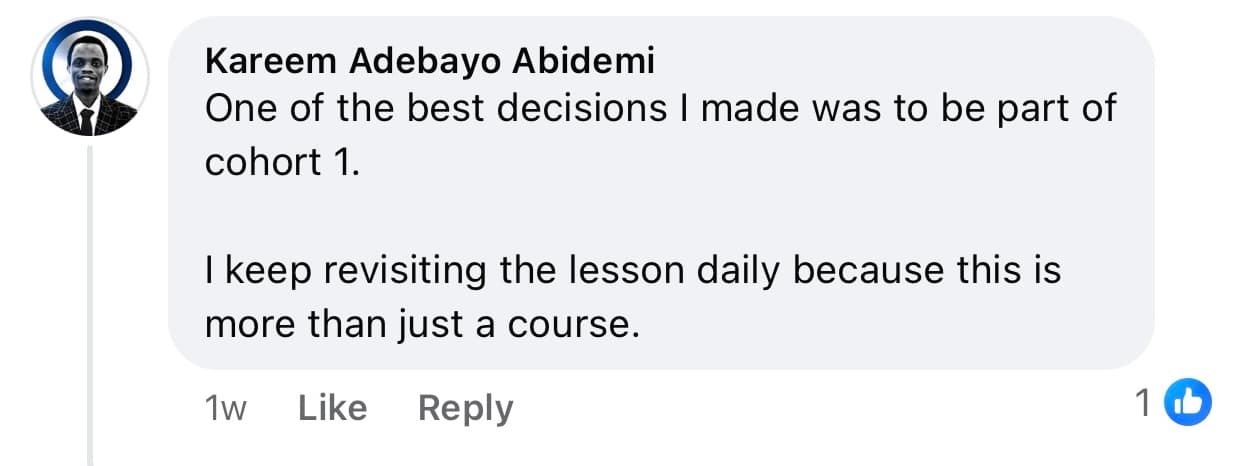
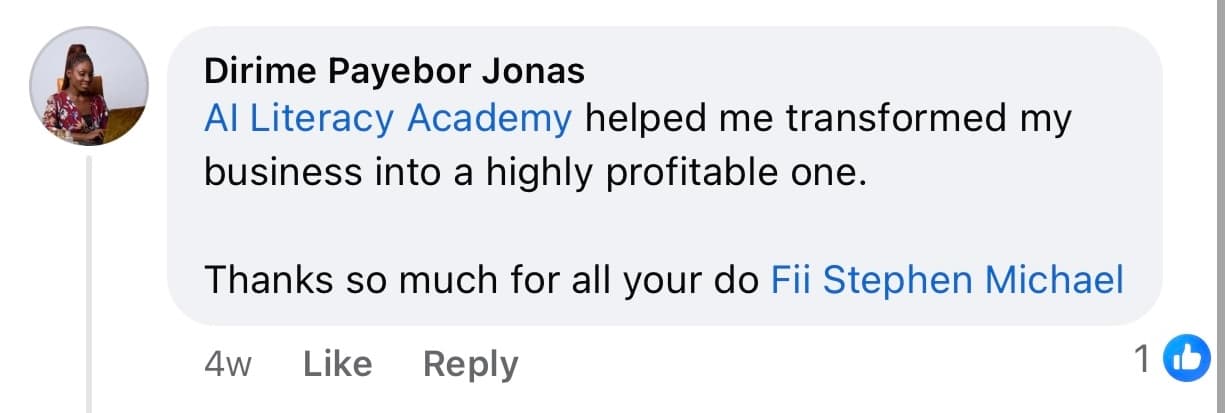
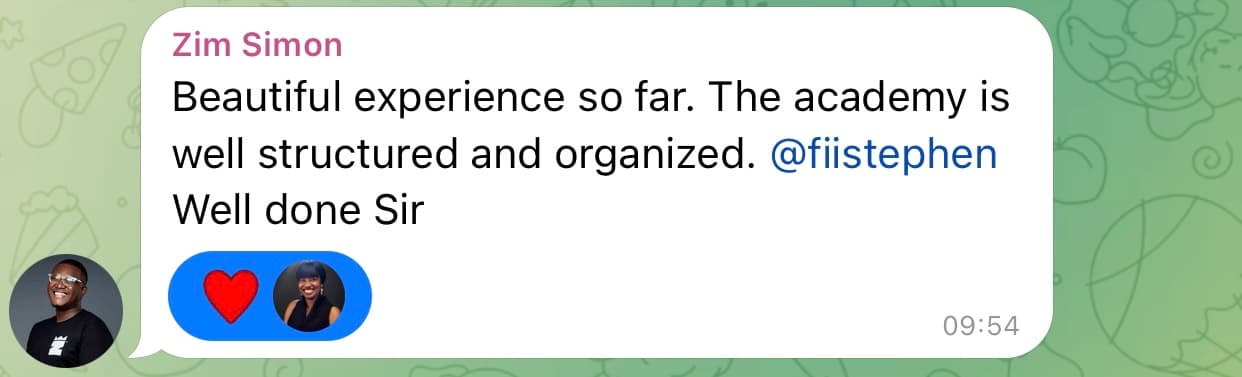
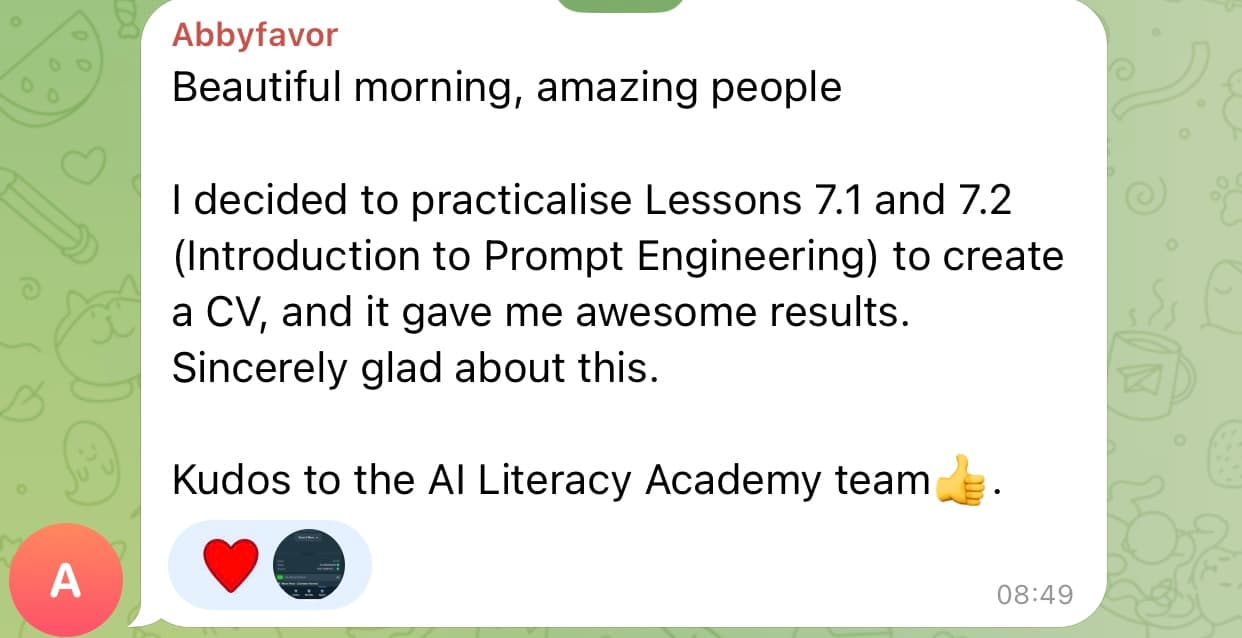
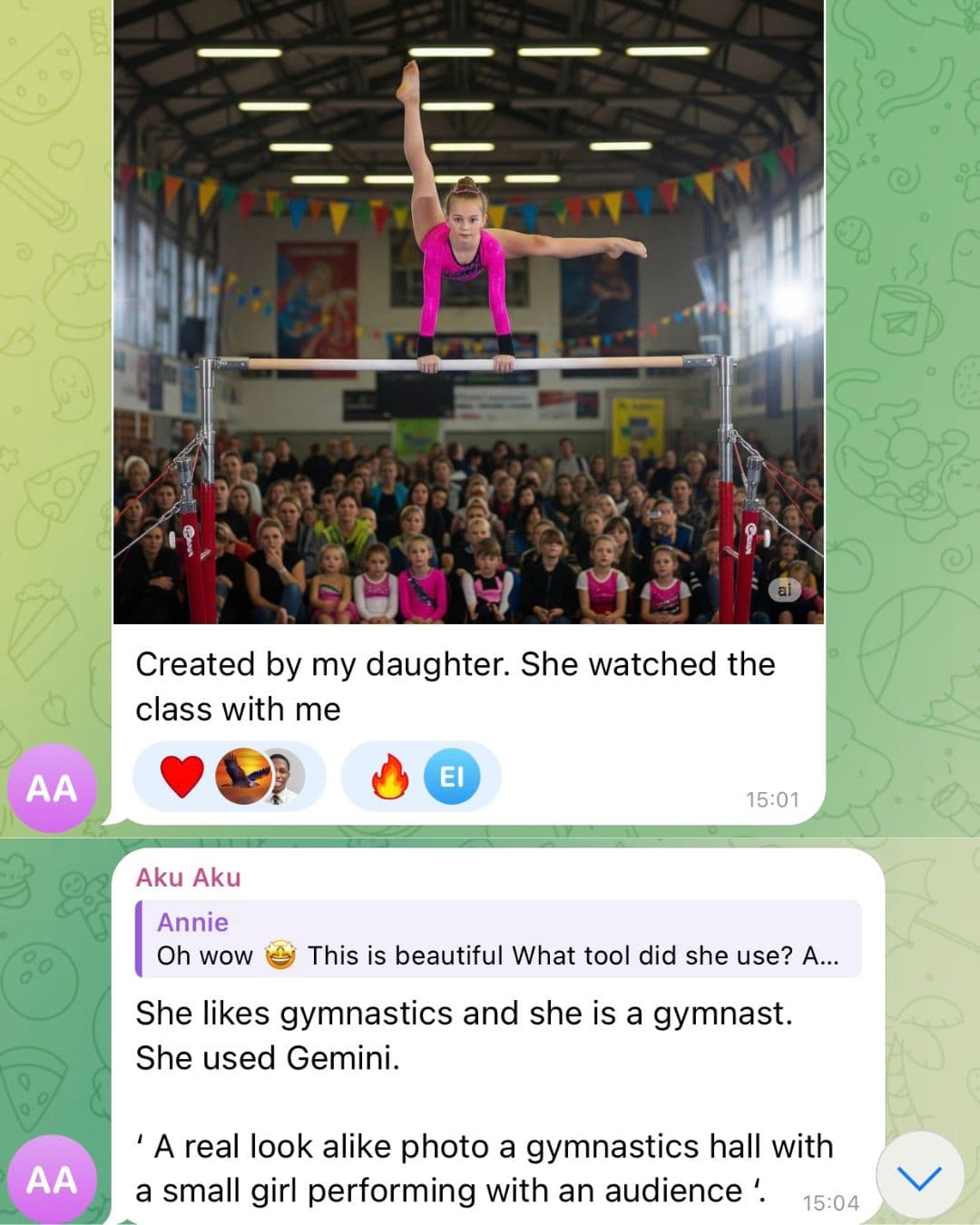
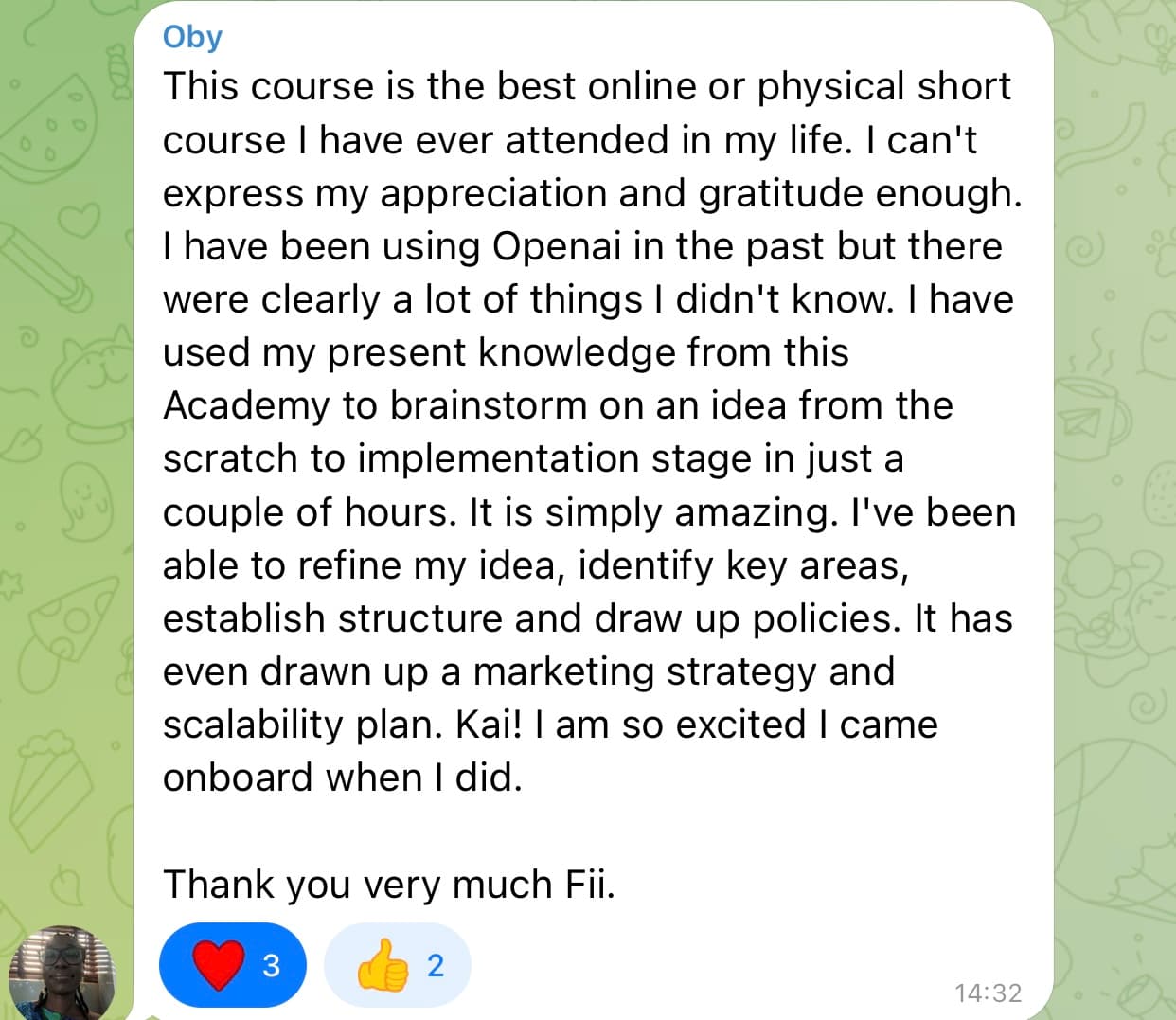
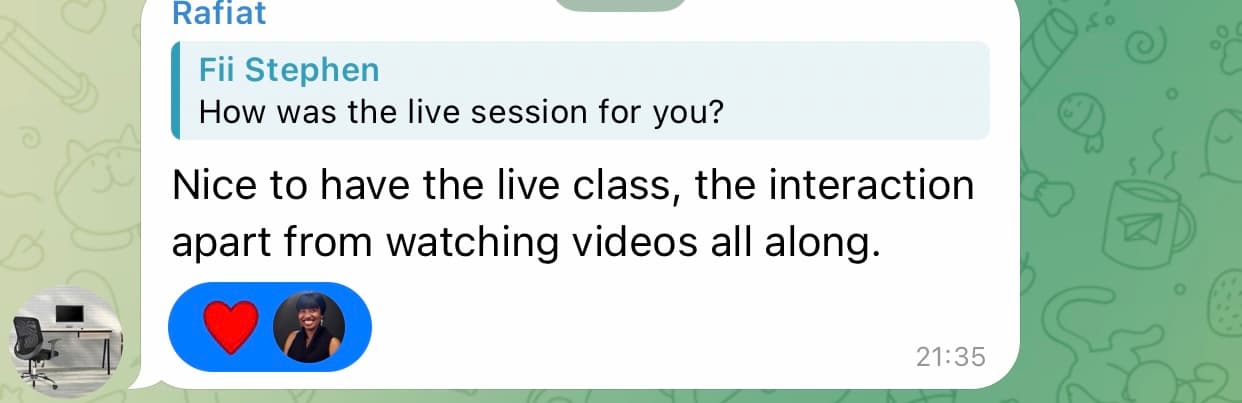
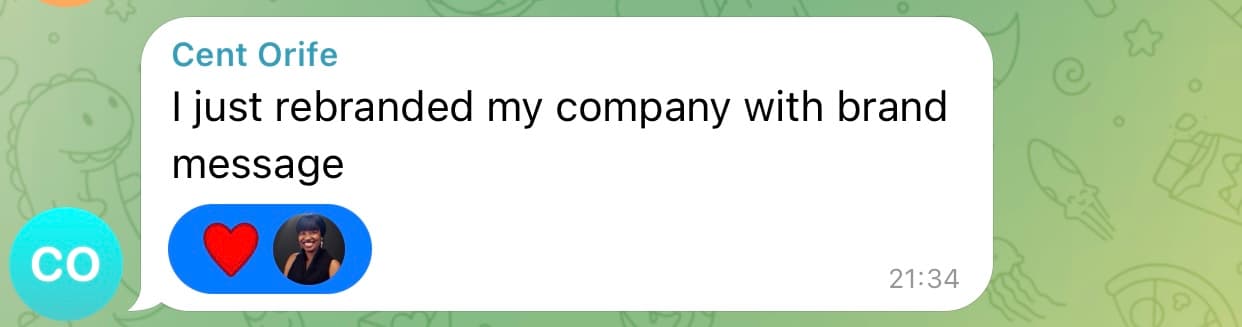
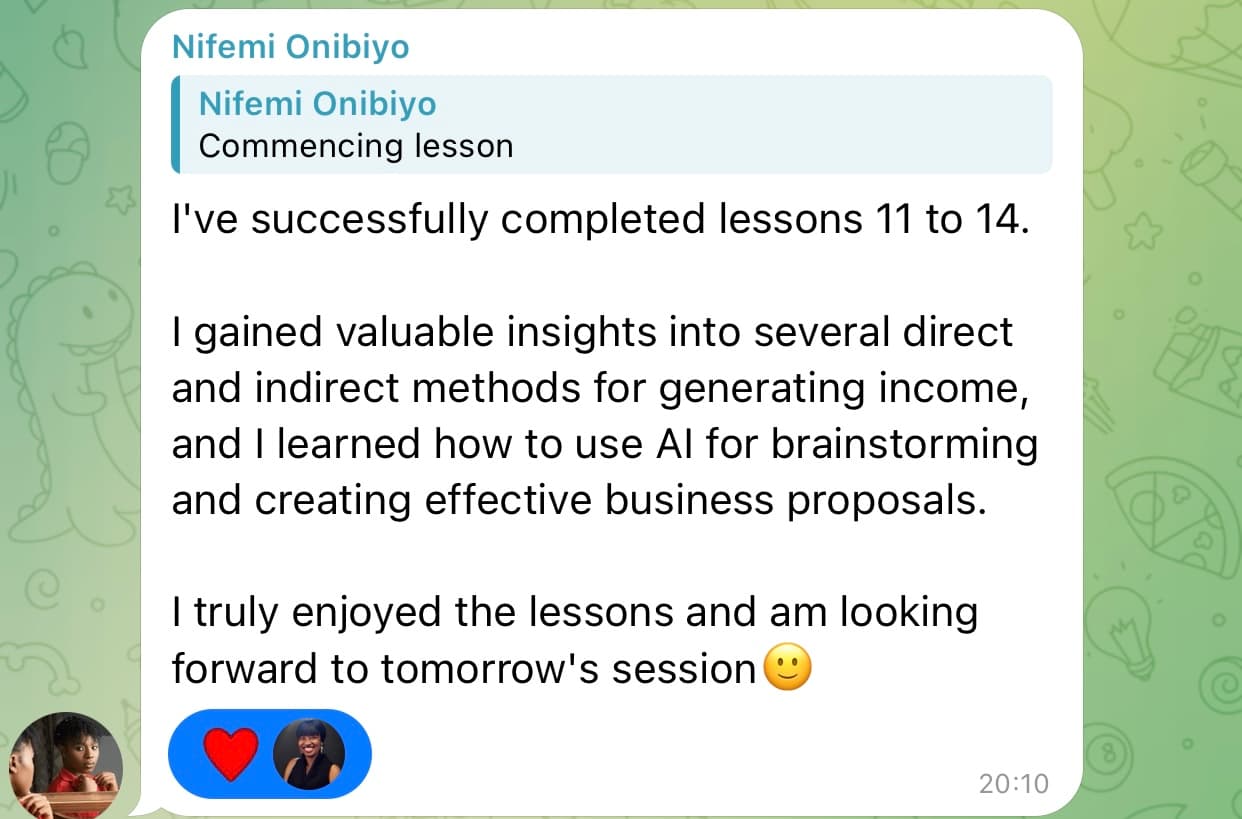
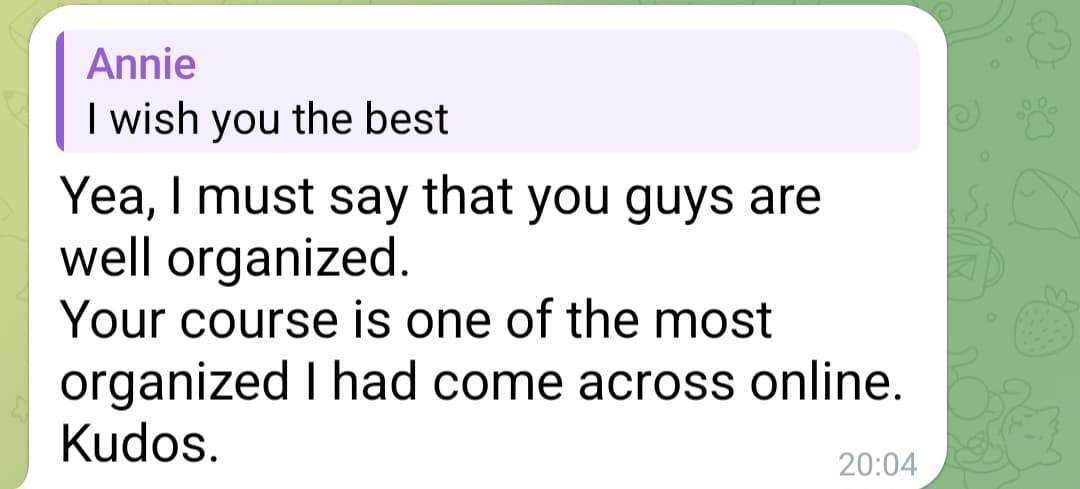
See what other people are saying
One price. Full access.
Cohort 7 - August 2026 — August 2026. Includes one year of post-cohort access to all materials.
Cohort 7 - August 2026
₦48,375
or $40 USD for international students
- Access to 40+ Video Lessons
- Templates & Frameworks
- Community & Support
- Live Sessions & Replay
- AI Literacy Certification
Cards · Bank Transfer · Apple Pay
You will get these Bonuses too:
AI Tools Cheat Sheet & Resource Library
A curated list of free and affordable generative AI tools.
Exclusive AI Prompts Vault
100+ ready-to-use prompts for content, marketing, and business automation.
Your First ₦300,000 Freelancing Roadmap
A complete guide to monetizing AI skills through freelancing or side hustles.
AI-Driven Marketing Templates
Landing page, email sequence, funnel, and social media calendar templates.
AI Revenue & ROI Workbook
Measure time saved, income earned, and costs reduced by applying AI skills.
Exclusive AI Business Case Studies
Learn how other small businesses grew revenue and professionals got better roles with AI.
Frequently asked questions
How long does the program take to complete?
When does the next Academy Cohort start?
What technical skills or prior knowledge do I need to join this program?
What if I miss a session?
What kind of certification will I receive?
Will this program really help me make money?
Are there any additional costs for tools or software?
What types of businesses benefit the most from AI?
How much time will I need to dedicate to this program as a busy career professional or business owner?
Can I use this program to start freelancing or a side hustle?
I'm not great with technology. Will this program be too difficult for me?
What support will I receive during the program?
I have another question. How can I contact you?
Become the next AI-skilled professional.
Learn everything you need to use AI in your career or business.
Join the AcademyJoin 1539+ alumni
Across 6 successful cohorts